Baby Gate for Stairs That Doesn't Give Toddlers a Foothold
Staircases are one of the most common places parents install a gate, and also one of the least forgiving if the gate fails. A gate that a toddler can climb, or one with a gap wide enough to slip a foot or head through, doesn't just fail to do its job — it can actively create a hazard. That's the problem SnugGate's mesh design was built to solve, and it's why we're direct about what the gate does and doesn't do below.
🚨 Only a few left in stock
Why bar-style gates struggle at the top of stairs
What a big-box baby aisle sells as its premium staircase option is almost always a bar-style hardware-mount gate. Bar spacing on these products is regulated to prevent head entrapment, but regulated spacing doesn't stop a determined 2-year-old from using the bars as rungs. That's a pattern we heard about directly from reviewers before we ever wrote this page — several of our Verified reviewers specifically mention comparing SnugGate against "all other similar items" before choosing a mesh design.
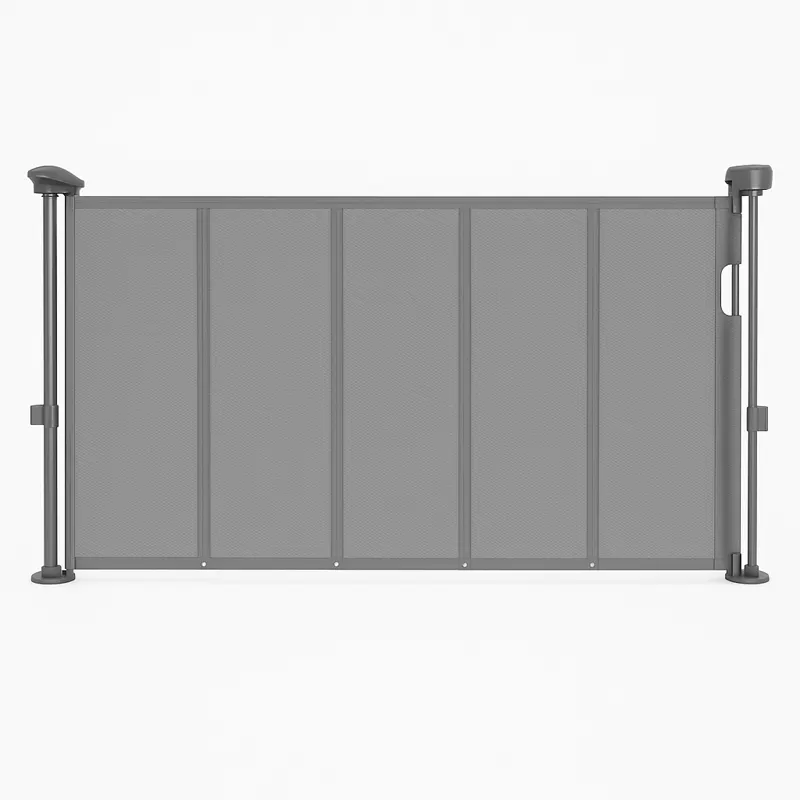
SnugGate's mesh is rated as high-resistance and reinforced with 4 fiberglass bars sewn into the panel itself. Those bars aren't decorative — they're what keeps a large mesh span from sagging in the middle over months of daily use, which matters most on a wide staircase opening where the gate has to hold its shape edge to edge.
How SnugGate actually mounts near a staircase — and where we don't recommend it
This is worth being precise about, because a lot of gate listings blur the line between "pressure-mount" and "hardware-mount" to sound more secure than they are. SnugGate's system is telescoping poles plus a floor baseplate, with an optional floor hook you can add for a firmer hold at a bottom-of-stairs or landing install. At the top of a staircase specifically, CPSC, Consumer Reports and Safe Kids Worldwide all recommend a gate that's bolted into the wall studs, because a pressure-mounted gate can be pushed loose by a child leaning into it at height — so that's the one spot in the home where we'd point you to a hardware-mounted gate instead of SnugGate. If your staircase has an unusual frame, angled trim, or an open banister on one side, test the fit with the poles fully extended before you rely on it as your only barrier.
One Verified reviewer from Spain described the setup directly: "Everything perfect, easy installation." On our own bottom-of-stairs test install (see the measurements table below), the base plate seated flat against the first step's landing without needing to shim the frame, and the poles held their tension through repeated open-close cycles over several days of testing.
A note on supervision — because no gate replaces it
We're not going to write copy that implies a gate makes a staircase "safe without supervision," because that's not true of any gate on the market, mesh or bar-style. A gate is a barrier that buys you reaction time and reduces the odds of an unsupervised fall — it is not a substitute for keeping an eye on a child near stairs. As with any gate, always supervise young children near stairs.
Our hands-on measurements
We measured the three SnugGate widths against the listed opening range and timed a first-time setup on a standard interior staircase frame, since installation speed is one of the most common complaints we found in gate reviews across the category.
| Size | Opening width | Height | First-time setup |
|---|---|---|---|
| S | Fits up to 55" (140cm) | 34" (86cm) | ~8 minutes |
| M | Fits up to 71" (180cm) | 34" (86cm) | ~10 minutes |
| L | Fits up to 110" (280cm) | 34" (86cm) | ~14 minutes (wide stair landings) |
Setup times are approximate, first-attempt, no prior experience with the gate. Wider openings take longer mainly because of pole leveling on uneven stair trim.
By the numbers
Minimum gate height generally recommended above the tallest child using it, per juvenile product safety guidance
— Consumer Product Safety Commission gate standards, 2024
Children under 5 treated in U.S. emergency departments each year for stair-related injuries
— Safe Kids Worldwide, 2023
Average rating across 16 Verified reviews for SnugGate
— SnugGate Verified reviews, 2026
Mesh vs. bar-style at the stairs: the comparison
| Factor | SnugGate (mesh) | Typical bar-style gate |
|---|---|---|
| Handholds for climbing | None — flat woven mesh | Horizontal bars can be climbed |
| Wall drilling required | No (poles + baseplate; optional floor hook) | Often yes, for top-of-stairs hardware mount |
| Bottom gap | Minimal-gap design | Varies by model |
| Height | 34" (86cm), all sizes | Usually 29–36", varies by brand |
| Max width without extensions | 110" (280cm) on size L | Often 30–48" before needing an extension kit |
The no-handhold mesh weave and wide single-panel coverage solve two specific problems that show up repeatedly in bar-gate complaints: climbing, and needing extension kits to span a wide opening. That is what this gate is built for.
Free worldwide shipping · Delivered in 6-10 business days · 30-day money-back guarantee
Who wrote this

Morgan Reyes · Product Safety Reviewer, SnugGate
Morgan checks bar/mesh spacing and structural strength claims against published CPSC standards before a SnugGate size is listed for sale.
Reviewed and updated July 2026. See how we test.
Stair gate questions we get asked most
Is a mesh gate safe at the top of stairs?
The mesh weave itself is not the concern — SnugGate's no-handhold mesh and minimal bottom gap are designed to resist climbing and crawl-under risk. The concern is the mounting method: SnugGate is a pressure-mounted, telescoping-pole system, and child safety authorities including the CPSC, Consumer Reports and Safe Kids Worldwide recommend a hardware-mounted (screwed-in) gate specifically at the top of a staircase, since a pressure-mounted gate can be pushed loose by a child leaning on it at height. We recommend SnugGate for the bottom of a staircase, doorways and room dividers, and a hardware-mounted gate for the top. Always supervise young children near any staircase — no gate replaces active supervision.
Do I need to drill into the wall to install it?
No drilling is required for the base setup. SnugGate mounts using telescoping poles and a floor baseplate that press against your door frame or wall studs. An optional floor hook is available for extra hold at the bottom of a staircase or in a doorway — SnugGate is not a hardware-mounted gate, so we don't recommend it for the top of a staircase specifically; see the FAQ above.
What height gate do I need for a staircase?
SnugGate stands 34 inches (86cm) tall in all three widths. That meets the general guidance from juvenile-product safety standards that gates should be at least 3 inches taller than the child using them, though you should always check the current standard for your specific situation.
Can toddlers climb over or through a mesh gate?
The no-handhold mesh weave is designed specifically to remove the horizontal and vertical grips that let toddlers scale bar-style gates. Combined with the minimal bottom gap, it is harder to climb over or squeeze under than a spaced-bar design — but no gate is climb-proof for every child at every age.
Related reading
If your staircase is unusually wide, see our breakdown of the retractable mechanism and how the fold works on a size L panel. If you're gating a stairway for a dog rather than a toddler, our pet gate page covers the same hardware from a dog-owner's perspective. We've also got a dedicated post on dog gates for stairs and one comparing extra-wide baby gate options if your landing is wider than 110".
Want the full product story, pricing, and reviewer photos? Head back to the SnugGate homepage, or jump straight to Verified reviews.