· Morgan Reyes
How to Install a Safety Gate: What It Presses Against, and How to Check It
Most of what goes wrong with a gate happens in the ten minutes it takes to put it up, and almost none of it is the gate's fault. A pole lands on a hollow patch of wall, a doorway turns out wider at the top than at the bottom, a rug edge lifts one end off the floor. Each is invisible unless you know to look. So this guide covers the part nobody explains: what your gate presses against, and how you confirm it is seated. Sizing is separate, and handled in our guide to measuring an opening.
First, the one rule that is not up for discussion
Everything else here is technique; this part is a rule. A pressure-mounted gate pushes outward against two surfaces — a strong and entirely adequate arrangement in a doorway, a hallway, a room divider or at the bottom of a staircase. At the top of a flight, the consequence of a gate moving is different in kind, so the recommendation is different too. SnugGate is a telescoping-pole system on a floor base plate with an optional floor hook, and it belongs at the bottom. Our baby gate for stairs page and the stairs guide for dogs cover that split in full. As with any gate, always supervise young children near stairs.
Your two anchor points decide everything else
Put a hand flat on each side of the opening, at roughly the height the poles will sit, and knock. Each side falls into one of four categories.
| What the side is made of | How to recognise it | What to do |
|---|---|---|
| Solid masonry, or a stud behind the surface | Dull, dead sound, no give under a thumb | Ideal. Tension holds indefinitely |
| Door casing or architrave | Timber frame around the opening | Usually the best anchor in the room — use it |
| Hollow plasterboard | Hollow ring, slight give | Workable, but move the pole first (below) |
| Something that moves | A spindle, loose skirting, a radiator, furniture | Not an anchor point. Find another spot |
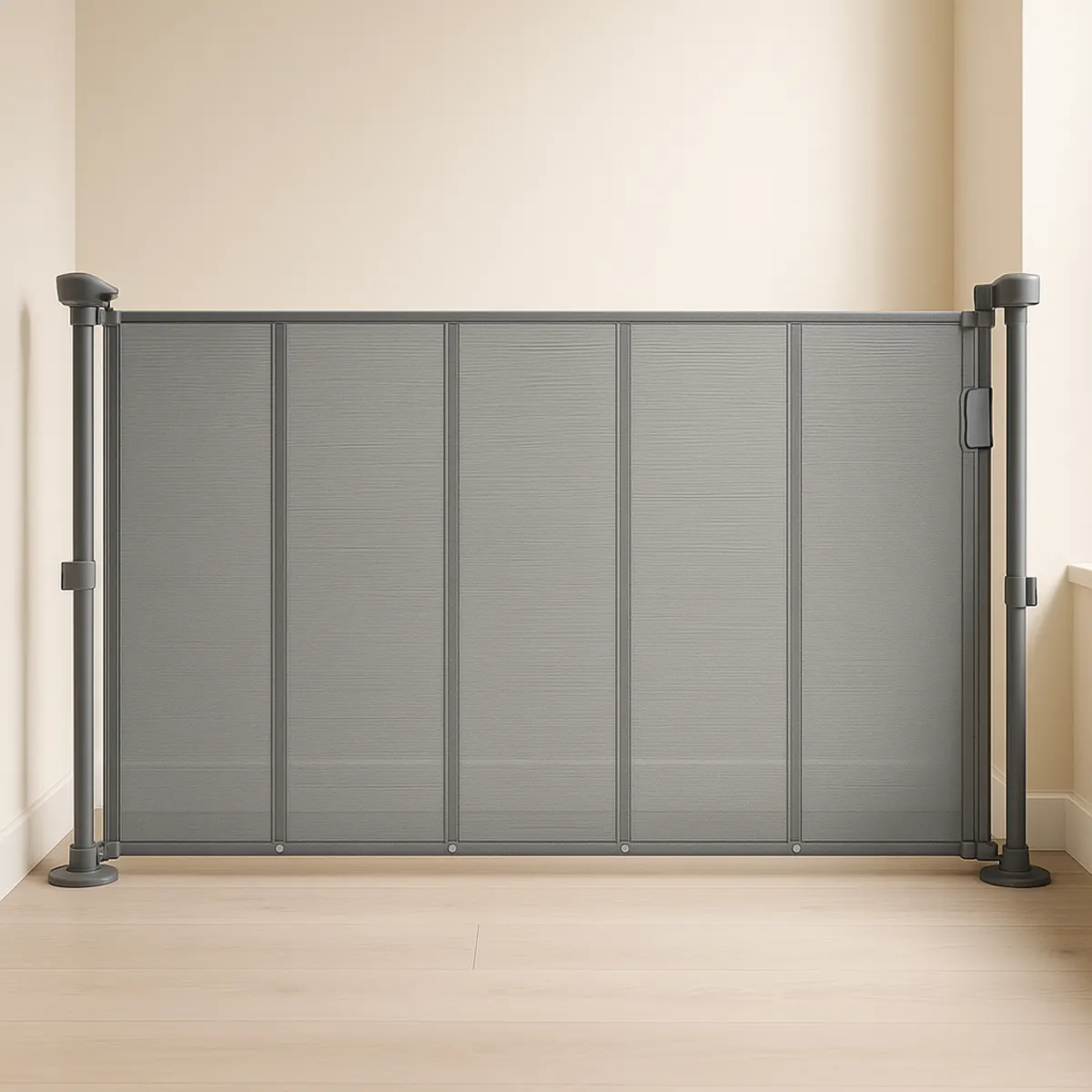
The two sides do not have to match. A door casing on the left and solid wall on the right is a perfectly good installation — what matters is that each pole, individually, has something firm behind it.
Hollow plasterboard: move the pole, do not fight the wall
Plasterboard is the surface people worry about most, and the fix is simpler than expected. The problem is not the material but the geometry: a pole seated mid-panel concentrates its load on the weakest square inch of the wall, and plasterboard answers that by dimpling.
So change position rather than adding force. Studs sit at regular intervals and door openings are framed with timber on both sides, so there is nearly always solid backing within a few inches of wherever you first placed the pole. Knock along the wall at pole height until the sound goes from hollow to dull, and set the gate there. Two habits go with it: keep the pole clear of the skirting board, often the least well-fixed timber in the room, and favour a wide contact pad over a small foot.
Banisters, newel posts and spindles
A banister is not one object. The newel post is a structural member fixed into the stair carriage, and it does not move when you lean on it. Spindles are infill: slender, fixed only top and bottom, and a pole tensioned against one bends it long before the gate feels solid. Grab each candidate and pull hard in the direction the gate will push — a newel post will not budge, a spindle flexes visibly. If only spindles line up with your opening, move the gate along until you reach the post or a wall. And a rounded or turned post gives the pole a curved surface, which lets it creep sideways under load, so seat it on the flattest face you can find.
When the opening is not square
Measure the width at floor level and again at the top of where the gate will sit. If the two differ, your walls are not parallel, which is entirely normal. Set the gate to the smaller of the two, always — fitted to the wider measurement it is loose at the narrow end, and loose at one end is simply loose.
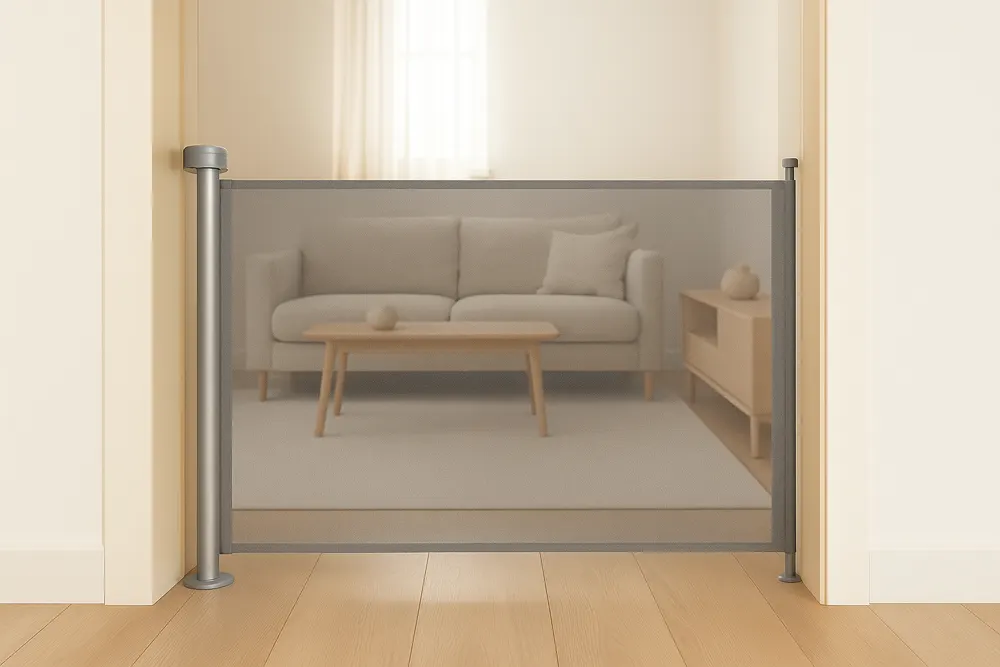
Sloping floors are the other half. Put the base plate down and look at it from the side — it should sit flat, with no rocking when you press each corner. If a corner lifts, move the plate rather than forcing it; a few inches along the threshold usually finds level ground. Threshold strips and rug edges are the frequent culprits: a rug under one pole raises that end, tilts the panel and opens a gap on the opposite side.
Fitting it: tension, settle, tension again
With the anchors chosen, the fitting is short. Seat the base plate flat and confirm it does not rock. Extend the poles until the panel comes up to tension, working them up gradually and alternately rather than taking one to full tension first, so the panel finishes vertical instead of pulled toward one wall. Then add the optional floor hook if the opening is a busy one, like a kitchen threshold or the foot of a staircase.
Then leave it an hour and come back. Every pressure-fit system settles a little as the pads bed into the wall surface, and a quarter-turn of re-tensioning afterwards is what separates a gate that stays put for months from one that wants attention every fortnight. It is the least glamorous step here and probably the highest-value one.
On SnugGate the tension comes from the poles rather than a rigid frame, which is how the panel spans a wide opening without sagging — the retractable mechanism breakdown covers that fold. Buyers describe the setup in much the same terms — a reviewer in Spain wrote "Everything perfect, easy installation." More sit on the reviews page.
The three checks that tell you the gate is fitted
1. The shake test. Put both hands on the top edge and push firmly, from one side and then the other — roughly where a child would lean. Watch three things: the poles should not walk along the wall, the base plate should not lift at any corner, and the panel should not go slack in the middle. If any of the three happens, re-tension and repeat. A properly fitted gate feels like part of the doorway when you push on it.
2. Sight along the top edge. Crouch until your eye is level with the top of the panel and look across it. It should run level from side to side. An edge that dips toward one end means the poles are at different heights, usually because one slipped during tensioning. SnugGate stands 34 inches (86cm) tall across all three widths, so what you are confirming is that the gate delivers that height along the whole width, not only at one end.
3. Sight along the floor. Get down and look along the bottom edge. The panel is built with a minimal bottom gap by design, and what you are checking is that the gap is even across the full width, with no corner riding up over a rug or an uneven board. An even gap means the panel is square; a gap that grows toward one end says the base plate is not sitting flat.
Panel height on all three SnugGate sizes — the top edge should sight level at that height across the opening
— SnugGate product specifications, 2026
Fiberglass rods sewn through each mesh panel, which is what holds it flat
— SnugGate product specifications, 2026
Average rating across 16 Verified reviews, several describing the setup itself
— SnugGate Verified reviews, 2026
What changes after a few weeks
Wall surfaces compress slightly under sustained pressure and timber moves with the seasons, so the habit worth keeping is a five-second shake test whenever you pass the gate. Three moments deserve a proper re-check: after the first week, once the settling has finished; after you move the gate to another opening, which is a fresh installation each time; and after any change to the floor underneath. If you are also gating for a dog, the load arrives differently — the pet gate page covers what to watch there.
Frequently asked questions
How do I fit a safety gate on a hollow plasterboard wall?
Move the pole rather than fight the wall. Slide the gate along the opening until each pole sits on something solid: the door casing, a corner where two walls meet, or a stud. Follow the fitting instructions supplied with your gate.
Can I fit a pressure-mounted gate at the top of a staircase?
No, and this one has no exceptions. CPSC, Consumer Reports and Safe Kids Worldwide all recommend a hardware-mounted, screwed-in gate at the top of a staircase, because a pressure-mounted gate can be pushed loose by a child leaning into it at height. SnugGate is the gate for the bottom of a staircase, doorways and room dividers; use a hardware-mounted gate at the top. As with any gate, always supervise young children near stairs.
My doorway is wider at the top than at the bottom. Is that a problem?
Common in older homes, and workable. Set the gate to the narrowest measurement in the opening, seat the base plate flat first, then bring each pole up to tension separately so the panel finishes vertical rather than following the wall.
How tight should the poles be?
Tight enough that the panel stays flat and nothing shifts when you push at the top edge, and no tighter. The instructions supplied with your gate give the tension setting for your model.
Get the anchors right and the checks done, and a gate settles into being the least interesting object in the house. Sizes, colors and pricing are on the SnugGate homepage; the panel material guide covers the barrier itself.

Morgan Reyes · Product Safety Reviewer, SnugGate
Morgan checks bar/mesh spacing and structural strength claims against published CPSC standards before a SnugGate size is listed for sale.
Published August 2026. See how we test.
Free worldwide shipping · Delivered in 6-10 business days · 30-day money-back guarantee