· Morgan Reyes
What Can I Use Instead of a Baby Gate? Real Alternatives Compared
People asking this question usually have a concrete reason: a rental agreement that rules out drilling, an opening wider than anything in the store, or a baby who arrived faster than the babyproofing budget. Those are legitimate constraints, and the alternatives below are legitimate tools — parents used all five for generations before anyone sold a safety gate. What this guide adds is the part the forum answers skip: what each one actually does, the exact point where it stops, and which of the original constraints it genuinely solves — because the most common one, no drilling, turns out not to require an alternative at all.
First, the job you are trying to replace
A gate at a doorway or a staircase is doing three things at once, and any substitute has to be scored against all three, not just the first. It blocks the opening against a child who has every intention of getting through. It stays put under load — a toddler leaning, pulling and rattling is the normal operating condition, not the failure case. And it lets adults through dozens of times a day, one-handed, with a laundry basket, without dismantling anything. Most alternatives handle the first requirement; the second and third are where they separate — because a barrier the adults hate crossing gets left open, and a barrier left open is furniture.
A closed door: the strongest barrier you already own
Start with the option that costs nothing, because for the right opening it is genuinely the complete answer. A solid interior door on a latch beats any gate on pure blocking power: nothing to climb, nothing to squeeze under, nothing to lean loose. If the goal is keeping a crawler out of a home office, a laundry room or a bathroom — rooms the child never needs supervised access to — close the door and the problem is closed with it.
Where the door stops working is exactly where most gate shopping starts. A staircase has no door. An open-plan kitchen has no door. In the openings that do have one, the door only protects while every person who passes remembers to shut it — a condition that fails by mid-morning in a busy household. A shut door also cuts both ways: you cannot see, hear or ventilate through it. Doors excel at excluding a child from a room permanently; they have nothing to offer the opening you and the child both live around.
A playpen or play yard: contain the child, not the opening
The play yard flips the logic. Instead of blocking the hazard, it encloses the child: a portable, self-standing pen you can set down in any room. For short, supervised stretches it is excellent at exactly that — twenty minutes while dinner comes together, a shower, a delivery at the door. It needs no walls to press against, moves house easily, and doubles as a familiar space at the grandparents'.
Its limits are built into the concept. A pen does not make the house safe; it pauses the house, for as long as the child accepts being paused. A new walker tolerates it; a toddler treats the perimeter as a project, and once climbing starts, the pen is done as a safety measure. It also ignores the architecture — the staircase is still open the moment the child is out. Pens and gates are not really competitors: one buys contained minutes, the other manages an opening all day.
Furniture barricades: the option everyone tries once
Sliding a bookcase, an ottoman or a box across a doorway is the improvised classic, and as a five-minute measure with an adult in the room it does hold a crawler back. As anything more, it fails all three tests at once. Anything light enough to drag into position is light enough for a determined toddler to push aside, and everything else is climbable — a barricade with a flat top is not a wall, it is a step. Unanchored furniture near a child adds a tipping hazard where there was none. And it fails the adult test hardest: every crossing means moving the thing, so within days it lives permanently ajar. Keep the barricade for what it is — a stopgap while a real barrier goes up — and note that the reason it appeals, no drilling, no commitment, is a constraint a tension-mounted gate already meets properly.
Rearranging the room: remove the hazard instead of blocking it
The quietest alternative is to change what the room contains rather than whether the child can enter it. Move the floor lamp out, anchor the shelving to the wall, cover the outlets, lift the cords, put the breakables a shelf higher. This is not a substitute for a gate so much as the layer that should exist under one — every safety checklist starts here, and a room that has been through it is safer whether or not a barrier ever goes up.
Its boundary is just as clear: rearranging works on objects, not on architecture. You can move a lamp; you cannot move the staircase, the stove, or the doorway to the garage. Some rooms can be emptied of hazards, and some hazards are the room. For the first kind, rearranging may be all you need. For the second, the question is back to controlling the opening.
Supervision: the layer that everything else assumes
Watching the child is the baseline every safety organization puts first, and nothing on this page — gate included — replaces it. We say the same thing on our stairs page: a barrier reduces risk; it does not stand in for an adult. The real question is whether supervision alone can be the whole plan, and an ordinary day answers that. Eyes leave the child to stir a pan, carry laundry, answer the door, use the bathroom. Those minutes are precisely when a mobile baby moves, and they are the minutes a physical barrier exists for. Supervision plus a controlled opening is a system; supervision alone is a system with scheduled gaps in it.
Every alternative against the job, side by side
| Option | What it does well | Where it stops |
|---|---|---|
| Closed door | Total block on rooms the child never needs to enter | Useless on stairs and open plans; no visibility; only works if always shut |
| Play yard | Contains the child for short, supervised stretches | Outgrown at climbing age; leaves the actual openings uncontrolled |
| Furniture barricade | Emergency stopgap with an adult present | Pushable, climbable, a tipping risk, and a nuisance to cross |
| Rearranging the room | Removes object hazards; the layer under any other measure | Cannot move a staircase, a stove or a doorway |
| Supervision | The non-negotiable baseline, always | The day has minutes when eyes are elsewhere — by design |
| Mesh safety gate | Blocks the opening, holds under load, opens on demand for adults | Top of stairs calls for a screwed-in, hardware-mounted gate |
Read down the middle column and each alternative is strong in one scenario — the excludable room, the contained minutes, the emergency, the object hazards, the watched hours. Read the right column and they all stop at the same place: the opening the household lives through — the kitchen doorway, the bottom of the stairs, the wide gap between living and dining room. That opening needs to be blocked, hold a leaning toddler, and still let an adult through with full hands: the three-part job a gate was designed around.
Where the alternatives stop, the gate is the tool
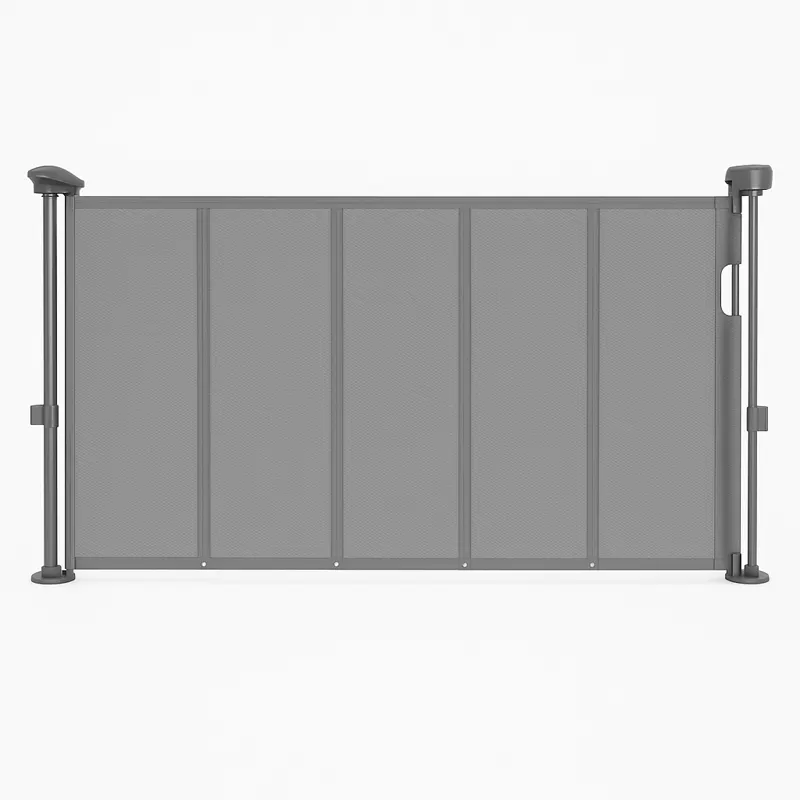
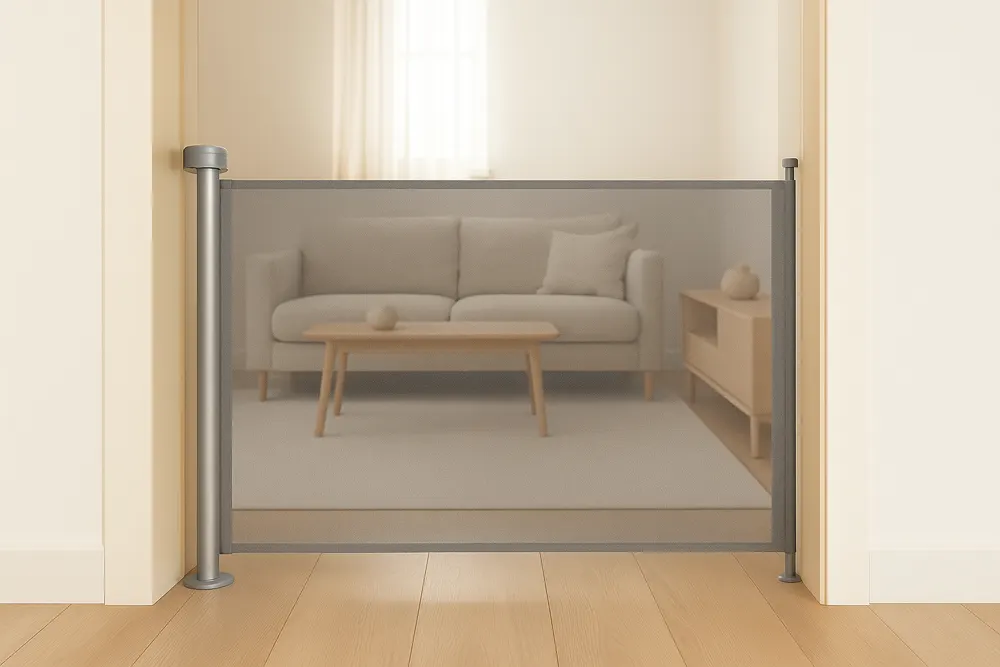
Here is the part that surprises people who arrived looking for a workaround: the most common reason for wanting an alternative — not being allowed, or willing, to drill into walls — is a constraint a modern gate already solves. SnugGate mounts with telescoping poles and a floor base plate: pressure against the two sides of the opening, an optional floor hook for busy thresholds, and no screws in the wall, which makes it as rental-friendly as the furniture barricade without any of its failure modes. The retractable mesh design folds away when you want the opening back, the panel stands 34 inches (86cm) tall with 4 fiberglass rods keeping it taut under a leaning child, and the three sizes span openings from 55 up to 110 inches — the wide gaps that defeat doors and barricades are covered in our extra-wide guide. One placement rule carries over from everything above: at the top of a staircase, CPSC, Consumer Reports and Safe Kids Worldwide all recommend a hardware-mounted, screwed-in gate, so SnugGate belongs at the bottom of the stairs, in doorways and across wide openings — the full reasoning is on the stairs page.
Panel height on all three SnugGate sizes — nothing for a toddler to climb, no bars to grip
— SnugGate product specifications, 2026
Maximum opening width on the Large size — spans the open-plan gaps no door or barricade can
— SnugGate product specifications, 2026
Average rating across 16 Verified reviews, many from households that tried the improvised options first
— SnugGate Verified reviews, 2026
If the household includes a dog, the same gate covers that opening too — the pet gate page walks through what changes — and if the two labels confuse you, our pet gate vs. baby gate comparison settles it. When the gate arrives, fitting it correctly takes ten minutes and the installation guide covers every wall type, including the plasterboard that scares renters.
Frequently asked questions
Can I use a playpen instead of a baby gate?
For short, supervised stretches, yes — a play yard contains the child while you cook or answer the door. It does not block a staircase or a doorway, and a climbing toddler outgrows it. A gate manages the opening itself, all day, without containing anyone.
Is a closed door enough instead of a baby gate?
For a room the child never needs to be near — a home office, a storage room — a closed door is a complete answer. It stops working in the openings a household walks through all day, because a door only protects while every person who passes remembers to shut it, and you cannot see or hear the child through it.
What can I use instead of a baby gate at the stairs?
At the top of a staircase, the recommendation from CPSC, Consumer Reports and Safe Kids Worldwide is a hardware-mounted, screwed-in gate — not a barricade, a playpen or an open plan. At the bottom of the stairs and in doorways, a pressure-mounted mesh gate like SnugGate does the job without drilling. As with any gate, always supervise young children near stairs.
Can I block an opening with furniture instead of a gate?
For a few minutes, with you in the room, it can hold a crawler back. Anything light enough to drag into a doorway is light enough for a toddler to push, climb or pull over, and unanchored furniture near a child is its own hazard. Treat a barricade as a stopgap while a real barrier goes up, not as the plan.
Use the alternatives for what they are good at: doors on the excludable rooms, a pen for the contained minutes, a cleared and anchored room underneath it all, and eyes on the child always. For the opening your family walks through fifty times a day, put the purpose-built tool in it. Sizes, colors and pricing are on the SnugGate homepage.

Morgan Reyes · Product Safety Reviewer, SnugGate
Morgan checks bar/mesh spacing and structural strength claims against published CPSC standards before a SnugGate size is listed for sale.
Published August 2026. See how we test.
Free worldwide shipping · Delivered in 6-10 business days · 30-day money-back guarantee