· Morgan Reyes
Will a Baby Gate Stop a Cat? What Works for Cats Instead
People typing this question are usually solving one of four problems: a new kitten that needs to stay in one room, a dog that raids the litter box, a crawling baby heading for the litter corner, or an adult cat that treats the whole house — counters included — as its territory. A gate is the right tool for three of those four. This guide separates them, then covers the deterrents that do work on the one problem a barrier cannot touch.
Why a standard gate is one easy hop for an adult cat
Every SnugGate size stands 34 inches (86cm) tall. A healthy adult cat lands on kitchen counters, dressers and refrigerator tops higher than that as a matter of daily routine — the vertical jump is the animal's signature move. A gate blocks by occupying the opening, and that logic assumes the one being blocked has to go through it. A cat does not. It goes over, usually on the first day, sometimes after a week of pretending the gate has beaten it.
This is not a defect in the gate. No doorway gate of ordinary height stops a determined adult cat, and a taut mesh panel was never designed as cat-proofing — it was designed to stop toddlers and dogs, two audiences that cannot leave the ground. The whole trick to using one well in a cat household is knowing which audience your barrier actually addresses, and that is where the rest of this guide goes.
Will a baby gate stop a kitten?
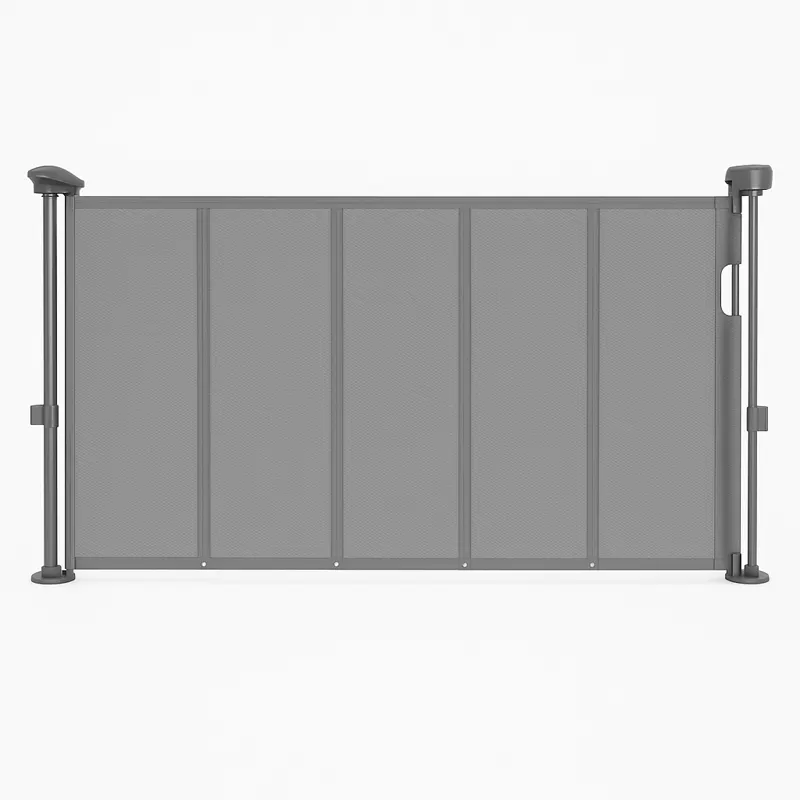
Yes — for the stage of life where you most need it to. A small kitten can neither clear 34 inches from the floor nor climb its way up, because the same anti-climb logic that works on toddlers works on tiny paws: taut woven mesh offers no bar to grip and no foothold to push from. A kitten meets the panel, pats it, and stays put.
That makes a gate genuinely useful for the settling-in period: keeping the newcomer to one room while the rest of the house is kitten-proofed, holding it back from a staircase it is not ready for, or managing first introductions — the mesh is see-through, so the resident dog and the new kitten can watch and smell each other across it without contact. Treat it as a stage tool with an expiry date: as the kitten grows into its jump, the barrier quietly converts from a wall into the filter described next. Nothing about the gate changes; the cat does.
The real reason cat households buy a gate: it filters
Here is the reframe. In a home with more than one species, the gate's job is usually not to stop the cat at all — it is to stop everyone else while the cat keeps its access. A barrier the cat can hop and the dog cannot is not a failure; it is a one-way door you did not have to cut into the wall.
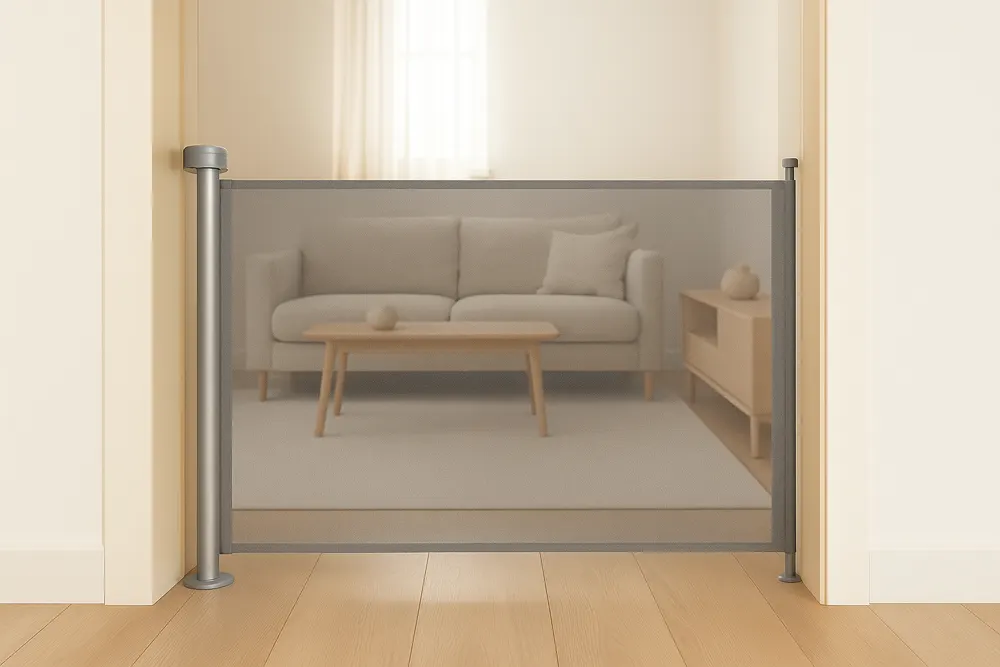
The classic case is the dog and the litter box. Park a mesh gate across the doorway of the litter room and the dog is out: nothing to squeeze between as with bars, nothing to climb, and a minimal bottom gap that shuts down nosing underneath — while the cat clears the top and gets a dog-free zone for its litter and food. The same setup separates feeding stations when the dog finishes the cat's bowl. What holds the dog side together — the 4 fiberglass rods that keep the panel taut under a leaning dog, the floor hook for extra hold — is covered on our pet gate page and, for stair openings, in the dog gate for stairs guide.
The second case arrives with a baby: a crawler and a litter tray in the same reachable space. Gate the litter corner's doorway and the baby stays on the clean side while the cat comes and goes over the top, no door held ajar, no tray relocated to a spot the cat rejects. Households running both problems at once — puppy plus cat, baby plus litter — are the exact scenario a dual-use mesh gate was built for, and three widths spanning openings up to 110 inches cover the open-plan versions of these rooms too. If the pet-versus-baby labeling itself is what confuses you, our pet gate vs. baby gate comparison settles that one.
What is the best doorway gate for cats?
Split the question by the job, because the two jobs point at two different tools.
If the goal is keeping the cat itself out of a room, no ordinary doorway gate does it, and raising the height mostly moves the bar without removing the athlete — a fit adult clears or climbs most household barriers. The tool for a genuinely cat-free room is a door that latches, and the fuller tour of non-gate options — doors, play yards, room changes — is in our alternatives guide, so this article will not repeat it.
If the goal is the filter — cat through, dog and baby not — then the criteria are concrete. You want a see-through panel, because a barrier both animals can watch through keeps the two sides calmer than a solid divide. You want mesh rather than bars, since bar spacing that merely inconveniences a toddler is an open door to a cat-chasing puppy's muzzle — and a ladder for the toddler. You want a minimal bottom gap, so the only way past is the top hop that only the cat can make. And you want a clean top line with a clear landing area on both sides, so the cat's crossing stays easy and routine. That combination — taut see-through mesh, no bar spacing, minimal gap at the floor — is precisely the SnugGate design brief, which is why the filter setup works with it out of the box.
Do cats eventually learn to stay off counters?
Yes — once the counter stops paying. Cats repeat what rewards them, and a kitchen counter pays out in three currencies: food left in reach, warmth near appliances, and a commanding view of the room. Remove the payout and the behavior follows it out the door. Clear food and crumbs the moment cooking ends, and give the view and the warmth a sanctioned address instead — a cat tree or window perch placed higher than the counter. A cat that owns a better vantage point loses interest in the worse one.
Two things speed this up. Consistency: every person in the house enforces the same rule, because a counter that pays out once a week is a slot machine, and slot machines keep players. And patience with the method: shouting or squirt bottles mostly teach the cat to schedule its counter visits for when you are out, since the deterrent is you, not the counter. The deterrents that work stay behind when you leave — the subject of the next two sections.
What surface will cats not walk on?
Sticky ones, first and always. Cats step onto surfaces paws-first and recoil from tack, which is why strips of double-sided tape along a counter edge or across a forbidden windowsill are the classic trainer — harmless, cheap, and active twenty-four hours a day. Aluminum foil is the runner-up: the crinkle underfoot and the unstable feel send most cats straight back. A plastic carpet runner laid nub-side up does the same job across a wider zone, such as a doorless entry.
Use all of these as what they are: temporary training aids on the exact surface you are defending, paired with an allowed alternative nearby, and removed once the habit has faded. The point is not a permanently foil-wrapped kitchen — it is a few weeks of the surface itself saying no.
What smell do cats really hate?
Citrus tops the list. The scent of orange and lemon peel is strongly disliked by most cats, which makes fresh peel — laid along a windowsill, a counter edge or the base of a doorless opening — the gentlest deterrent in the house. The sharp smell of ordinary vinegar, wiped on a surface and left to dry, is the other reliable household option. Both fade within days, so the routine is refresh-and-repeat while the training holds are on.
Keep it to mild, everyday household scents like these, and skip concentrated or harsh preparations that were never meant to be used around animals. Keep expectations calibrated too: scent is a nudge, not a wall — it works best layered with the payout-removal and the textures above; three mild signals beat one strong one.
Which tool for which cat problem
| Situation | The tool that does the job |
|---|---|
| New kitten, first weeks home | Mesh gate across the doorway — it cannot clear or climb the panel yet |
| Dog raids the litter box or cat food | Gate the doorway: dog out, cat over the top |
| Crawling baby and a litter corner | Gate the litter room; the cat keeps its access |
| Dog and cat introductions | See-through mesh between them, contact-free |
| Adult cat in a no-go room | A latched door — see the alternatives guide |
| Counters and shelves | Remove the payoff, add a higher perch, tape or foil for a few weeks |
The pattern in the table is plain: every row where a physical barrier appears is a row where the cat is the one allowed through. That is the purchase decision in one line: you are buying dog-proofing and baby-proofing that the cat can skip over.
Panel height on all three SnugGate sizes — one clean hop for an adult cat, a full stop for a kitten, a toddler or a dog
— SnugGate product specifications, 2026
Maximum opening width on the Large size — wide enough to gate an open-plan litter or feeding zone in one span
— SnugGate product specifications, 2026
Average rating across 16 Verified reviews, including multi-pet households
— SnugGate Verified reviews, 2026
Frequently asked questions
Can a cat jump over a 34 inch baby gate?
A healthy adult cat can, in one hop — the same jump it makes onto a kitchen counter. That is exactly why cat households use the gate as a filter: the dog and the crawling baby stay on their side of the mesh, while the cat keeps its access by going over the top.
Will a baby gate keep my dog out of the litter box?
Yes — this is the single most common cat-household use for one. A mesh panel across the litter room doorway gives the dog nothing to squeeze through or climb, the minimal bottom gap stops nosing underneath, and the cat simply hops over. The dog-holding details are on our pet gate page.
How do I keep my cat out of a room that has no door?
A barrier the cat can jump is not the tool for that job. Make the doorless room uninteresting instead: no food, no open warm perch, a deterrent texture such as double-sided tape across the entry line for a few weeks, and an allowed perch or bed just outside it.
Should I buy a taller gate to stop my cat?
Extra height keeps a kitten contained for longer, but a fit adult cat clears or climbs most household barriers whatever the height. Decide whether the job is stopping the cat — a job for a latched door — or managing the dog and the baby around the cat, which a 34-inch mesh panel does well.
A baby gate will not stop your adult cat — nothing at doorway height will. Use the deterrents on the cat problems and use the gate on everything around the cat — the kitten weeks, the dog at the litter box, the crawler at the tray. Sizes, colors and pricing are on the SnugGate homepage.

Morgan Reyes · Product Safety Reviewer, SnugGate
Morgan checks bar/mesh spacing and structural strength claims against published CPSC standards before a SnugGate size is listed for sale.
Published August 2026. See how we test.
Free worldwide shipping · Delivered in 6-10 business days · 30-day money-back guarantee